
Karnataka · Bread
Ragi mudde
Also called ragi balls, ragi sangati, ragi kali, ragi sankati, finger millet balls, nachni balls
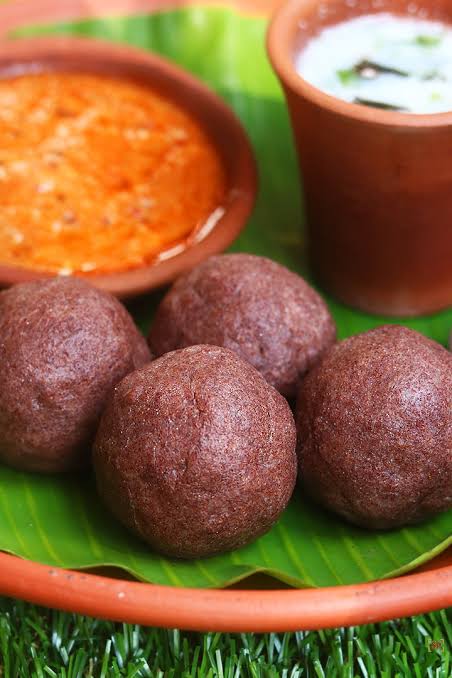
Soft, firm balls of finger millet (ragi) flour cooked in boiling water. The everyday staple of rural Karnataka, broken by hand and eaten with saaru, sambar or a soppu (greens) curry.
The short answer
Ragi mudde has about 134 kcal in a regular serving (1 ragi ball, about 170 g), with 2.9 g of protein and 4.4 g of fibre. It rates 4.0/5 (good fit) for weight management: it is low in calories for its weight and it is rich in fibre for its calories, but it is low in protein for its calories.
Reviewed by Deepu Oommen on 17 Nov 2026 · How we review
- Calories per serving
- 134 kcal
- 1 ragi ball (about 170 g)
- For weight management
- 4.0 / 5Rated 4 out of 5. Good fit for weight management
- Protein and fibre
- 2.9 g · 4.4 g
- per serving
- Brisk walking
- About 25 min
- uses similar energy (70 kg adult)
What's in ragi mudde?
Raw weights for one serving (1 ragi ball, about 170 g), from the standard recipe
- Ragi (finger millet) flour, 40 g
- Ghee, 1 g
- Water, 159 g
How is ragi mudde made?
Preparation 5 min · Cooking 15 min
- 1Mix a spoonful of the ragi flour with a little water into a smooth slurry.
- 2Boil the rest of the water with salt and a little ghee and stir in the slurry.
- 3Add the remaining flour in a heap and let it cook undisturbed on a low flame for a few minutes.
- 4Stir hard with a wooden stick until no lumps remain.
- 5Cover and steam for a few minutes until glossy.
- 6Wet your hands and shape the dough into balls while warm.
Ragi mudde nutrition
| Nutrient | Per serving (1 ragi ball, about 170 g) | Per 100 g |
|---|---|---|
| Energy | 134 kcal | 79 kcal |
| Protein | 2.9 g | 1.7 g |
| Carbohydrate | 26.7 g | 15.7 g |
| Fat | 1.5 g | 0.9 g |
| Fibre | 4.4 g | 2.6 g |
Calculated from a standard recipe (based on a recipe by Hebbar's Kitchen: Ragi Mudde (Ragi Balls), serves 3) using IFCT 2017 (ICMR-NIN) and USDA FoodData Central values for the raw ingredients, divided by the weight of the cooked dish (512 g for the whole recipe). Salt and dry spices are left out. The regular serving is the average portion in three chefs' recipes: Hebbar's Kitchen, Ragi Mudde (Ragi Balls) 171 g, Swasthi's Recipes, Ragi Mudde Recipe 224 g and Yummy Tummy Aarthi, Ragi Sankati (Ragi Sangathi) 128 g. Food composition: Longvah T, Ananthan R, Bhaskarachary K, Venkaiah K. Indian Food Composition Tables 2017, National Institute of Nutrition (ICMR), Hyderabad. How we calculate nutrition facts. Home and restaurant versions vary with the oil, rice and portion used.
Is ragi mudde good for weight management?
It rates 4.0/5, a good fit, because it is low in calories for its weight and it is rich in fibre for its calories, but it is low in protein for its calories.
- Calories per gram (35% of the rating)0.79 kcal · 94/100
- Protein per 100 kcal (25% of the rating)2.1 g · 22/100
- Fibre per 100 kcal (20% of the rating)3.3 g · 100/100
- Portion (20% of the rating)134 of 250 kcal (bread) · 96/100
Each part is scored against fixed limits, then weighted. A higher rating does not mean a food causes weight loss. How the rating works
Lighter ways to have ragi mudde
- Pair it with a dal-based saaru or sambar rather than a rich curry
- Add a bowl of greens or a vegetable side
- Keep the ghee to the little used in cooking; skip extra ghee on top
- One ball is a full serving of grain for a meal
Common questions about ragi mudde
How many calories are in ragi mudde?
About 134 kcal in 1 ragi ball, about 170 g, or 79 kcal per 100 g.
Is ragi mudde good for weight management?
It rates 4.0/5, a good fit: it is low in calories for its weight and it is rich in fibre for its calories, but it is low in protein for its calories. See the lighter ways to have it on this page.
How much protein is in ragi mudde?
About 2.9 g in 1 ragi ball, about 170 g, which is 2.1 g for every 100 kcal.
How much walking uses the energy in ragi mudde?
About 25 min of brisk walking for a 70 kg adult uses similar energy to one regular serving.
Is ragi mudde good for weight management?
Ragi is high in fibre and a ragi ball is mostly water, so a ball of about 170 g gives roughly 135 kcal and 4.5 g of fibre in this recipe.
Find ragi mudde near you
Opens Google Maps. NutriPedia does not see your location.
Compare it in:Indian breads
Information, not medical advice. Values are estimates for a typical recipe. Found an error? Tell us.