
Across India · Main meal
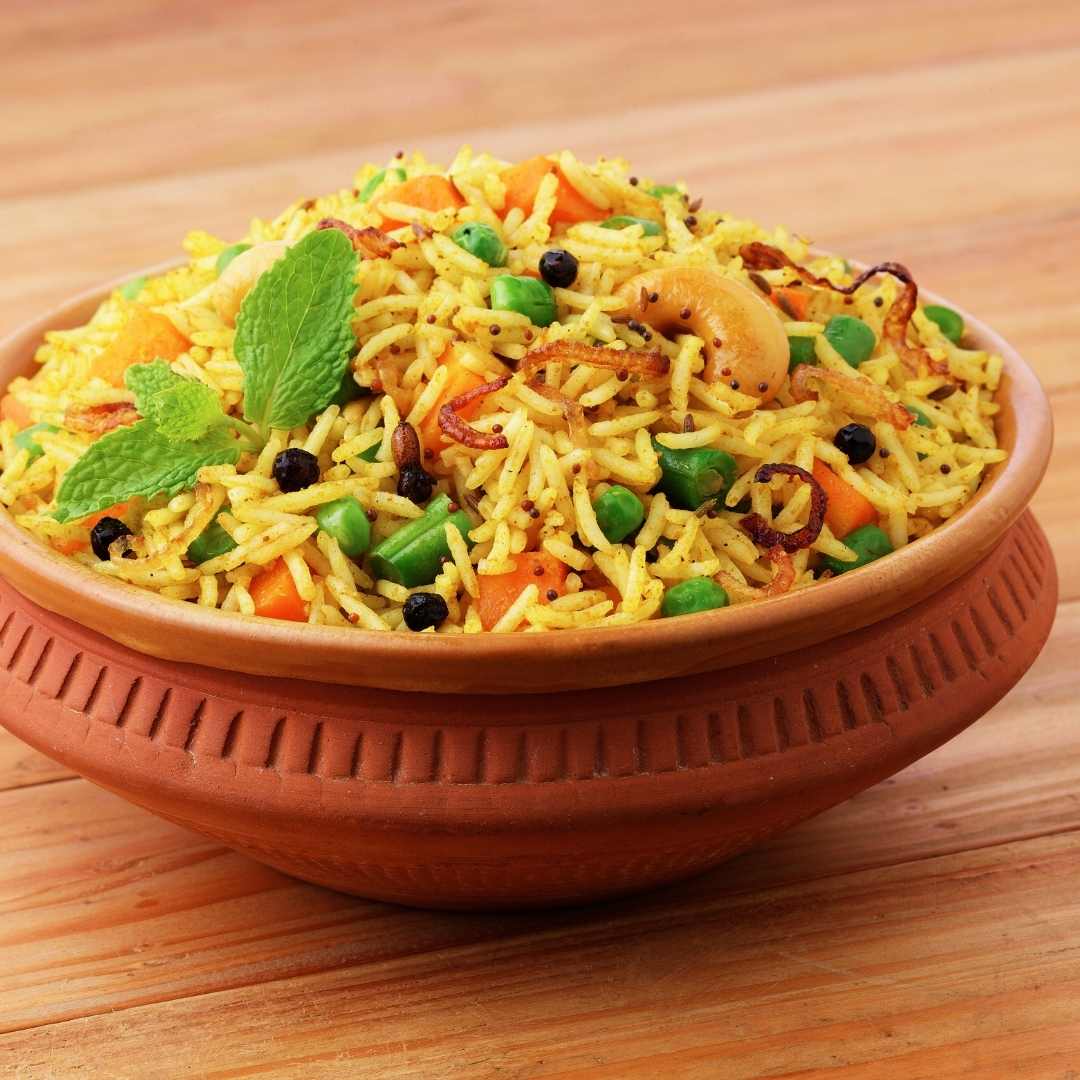
Vegetable biryani
Also called veg biryani, biriyani
Basmati rice layered with vegetables, golden fried onions and whole spices, then sealed and cooked slowly on low heat (dum) in the Hyderabadi style. Usually eaten with raita.
The short answer
Vegetable biryani has about 780 kcal in a regular serving (1 plate, about 500 g), with 15.5 g of protein and 14 g of fibre. It rates 2.0/5 (limited fit) for weight management: it is low in calories for its weight and it is rich in fibre for its calories, but a regular serving is a large portion and it is low in protein for its calories.
Reviewed by Deepu Oommen on 22 Oct 2026 · How we review
- Calories per serving
- 780 kcal
- 1 plate (about 500 g)
- For weight management
- 2.0 / 5Rated 2 out of 5. Limited fit for weight management
- Protein and fibre
- 15.5 g · 14 g
- per serving
- Brisk walking
- About 2 hr 30 min
- uses similar energy (70 kg adult)
What's in vegetable biryani?
Raw weights for one serving (1 plate, about 500 g), from the standard recipe
- Basmati rice, 81 g
- Potato, 86 g
- Carrot, 57 g
- French beans, 9 g
- Cauliflower, 39 g
- Onion, sliced and fried, 171 g
- Oil taken up in frying, 11 g
- Curd, 34 g
- Ginger paste, 6 g
- Garlic paste, 6 g
- Milk, 9 g
- Ghee, 15 g
- Cashew nuts, 2 g
- Almonds, 3 g
- Raisins, 5 g
- Mint leaves, 2 g
- Coriander leaves, 2 g
How is vegetable biryani made?
Preparation 40 min · Cooking 45 min
- 1Soak the rice for 30 minutes. Deep-fry the sliced onions until golden and drain them well.
- 2Mix the cut vegetables with curd, ginger and garlic paste, biryani masala, salt and half the fried onions, and leave to marinate for 30 minutes.
- 3Boil the rice in plenty of water with the whole spices and salt until it is about three-quarters cooked, then drain it.
- 4Heat the ghee in a heavy pot, cook the marinated vegetables for 2 to 3 minutes, add a little water and simmer briefly.
- 5Spread the rice over the vegetables. Top with the saffron soaked in milk, mint, coriander, the rest of the fried onions and the fried nuts and raisins.
- 6Seal the lid with dough and cook on a hot tawa over low heat (dum) for 15 to 20 minutes.
Vegetable biryani nutrition
| Nutrient | Per serving (1 plate, about 500 g) | Per 100 g |
|---|---|---|
| Energy | 780 kcal | 156 kcal |
| Protein | 15.5 g | 3.1 g |
| Carbohydrate | 105.5 g | 21.1 g |
| Fat | 32 g | 6.4 g |
| Fibre | 14 g | 2.8 g |
Calculated from a standard recipe (based on a recipe by Sanjeev Kapoor: Vegetable Hyderabadi Biryani, serves 4) using IFCT 2017 (ICMR-NIN) and USDA FoodData Central values for the raw ingredients, divided by the weight of the cooked dish (1750 g for the whole recipe). Salt and dry spices are left out. The regular serving is the average portion in three chefs' recipes: Sanjeev Kapoor, Vegetable Hyderabadi Biryani 438 g, Kunal Kapur, Veg Dum Biryani 504 g and Hebbar's Kitchen, Hyderabadi Veg Dum Biryani 554 g. Food composition: Longvah T, Ananthan R, Bhaskarachary K, Venkaiah K. Indian Food Composition Tables 2017, National Institute of Nutrition (ICMR), Hyderabad. How we calculate nutrition facts. Home and restaurant versions vary with the oil, rice and portion used.
Is vegetable biryani good for weight management?
It rates 2.0/5, a limited fit, because it is low in calories for its weight and it is rich in fibre for its calories, but a regular serving is a large portion and it is low in protein for its calories.
- Calories per gram (35% of the rating)1.56 kcal · 72/100
- Protein per 100 kcal (25% of the rating)2.0 g · 20/100
- Fibre per 100 kcal (20% of the rating)1.8 g · 60/100
- Portion (20% of the rating)780 of 550 kcal (main meal) · 8/100
Each part is scored against fixed limits, then weighted. A higher rating does not mean a food causes weight loss. How the rating works
Lighter ways to have vegetable biryani
- Ask for more vegetables and less rice, or fill half the plate with salad
- Have it with plain raita instead of fried sides like papad or chips
- At home, shallow-fry the onions or use fewer, and halve the ghee
- Keep to one plate and skip the second helping
- Add a protein side such as dal, a boiled egg or grilled paneer to feel full for longer
Common questions about vegetable biryani
How many calories are in vegetable biryani?
About 780 kcal in 1 plate, about 500 g, or 156 kcal per 100 g. A half plate has about 390 kcal.
Is vegetable biryani good for weight management?
It rates 2.0/5, a limited fit: it is low in calories for its weight and it is rich in fibre for its calories, but a regular serving is a large portion and it is low in protein for its calories. See the lighter ways to have it on this page.
How much protein is in vegetable biryani?
About 15.5 g in 1 plate, about 500 g, which is 2.0 g for every 100 kcal.
How much walking uses the energy in vegetable biryani?
About 2 hr 30 min of brisk walking for a 70 kg adult uses similar energy to one regular serving.
Is vegetable biryani healthier than chicken biryani?
It is a little lower in calories per plate, but chicken biryani has more protein. On NutriPedia both rate in a similar range; the portion and the oil used matter more than the choice.
Can I eat vegetable biryani at night?
Yes. What matters for weight management is the total for the day and the size of the plate, not the time you eat it.
Find vegetable biryani near you
Opens Google Maps. NutriPedia does not see your location.
Compare it in:Biryani
Information, not medical advice. Values are estimates for a typical recipe. Found an error? Tell us.