What did FSSAI find in its festive season drive?
FSSAI and state food safety departments inspected 56,431 food businesses between 1 September and 5 November 2026 and found 2,273 of 23,648 analysed samples non-compliant, about 9.6%. The figures were released by the regulator and reported by PTI on 8 November 2026.
The drive followed a letter from FSSAI to all state food safety commissioners dated 29 September 2026. It pointed to the surge in demand for sweets, savouries, edible oil and milk products such as ghee, khoa and paneer around Navratri and Diwali, and asked states to step up inspections and sampling and report results in real time.
| Action in the drive (1 Sept to 5 Nov 2026) | Number |
|---|---|
| Food businesses inspected | 56,431 |
| Samples collected | 43,939 |
| Samples analysed so far | 23,648 |
| Samples found non-compliant | 2,273 |
| Food seized | about 3,280 tonnes, worth about ₹81.8 crore |
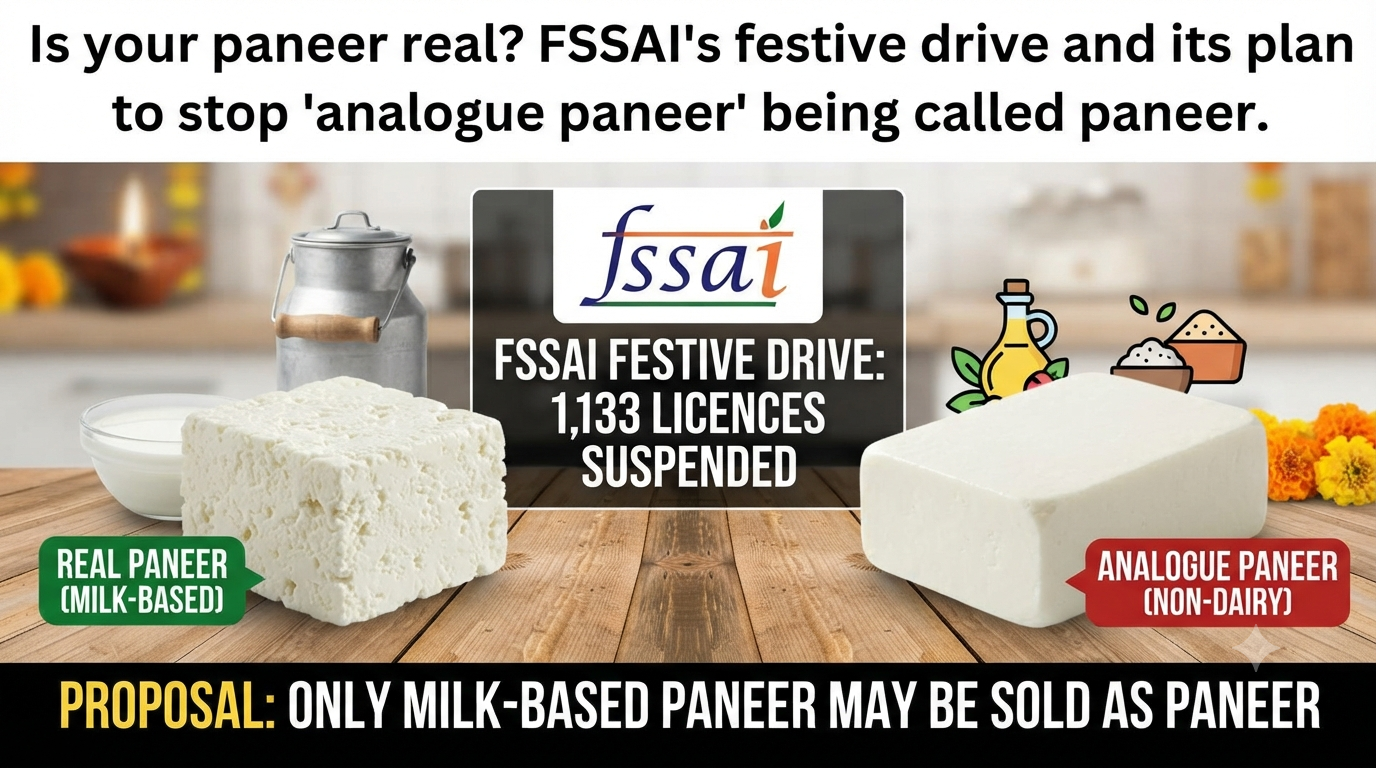
| Licences suspended | 1,133 |
| Licences cancelled | 52 |
| Premises sealed | 314 |
| Improvement notices | 10,047 |
| Prosecutions started | 410 |
Does "non-compliant" mean the food was unsafe?
Not necessarily. Under India's food law, a sample can fail for several reasons: it may be unsafe, it may be substandard (below the quality standard, such as too little milk fat), or it may be misbranded (a wrong or misleading label). The published totals do not split the 2,273 failures by type or by food.
So the 9.6% figure tells us the scale of problems found in festive-season sampling, which targets risky foods and places. It is not an estimate of how much of all the paneer or ghee sold in India is adulterated.
Nearly half the samples collected (about 20,300) were still waiting for results when the figures were released, so the final count may change.
What is analogue paneer?
Analogue paneer is a product that looks and is used like paneer but is made wholly or partly from ingredients that do not come from milk. FSSAI allows such products to be licensed under a category called "Analogue in Dairy Context", which is meant for foods that imitate dairy products.
The problem FSSAI describes is that these products are often sold, or served in food outlets, simply as "paneer". A buyer cannot tell the difference by sight, and the composition can be quite different from paneer made by curdling milk.
What does FSSAI's new draft rule say?
The draft would ban the sale of "paneer made of constituents not derived from milk". FSSAI published the draft Food Safety and Standards (Prohibition and Restrictions on Sales) Amendment Regulations, 2026, dated 22 September 2026, in the Gazette of India on 23 September 2026.
The notice says the aim is to stop consumers being misled about the nature and composition of the product. Businesses already licensed or registered under the analogue category would have to stop using the word "paneer" in the product name, labels and marketing.
The draft is open for objections and suggestions for 60 days from when the Gazette copies were made available, which puts the deadline around late November 2026. It becomes law only after FSSAI considers the comments and publishes a final notification.
Why does this matter if you eat paneer for protein?
It matters because paneer's protein comes from milk, and a product made with non-milk ingredients may give a different amount. Milk paneer has about 18.9 g of protein and 24.8 g of fat per 100 g in the Indian Food Composition Tables (ICMR-NIN). A 50 g portion gives about 9.5 g of protein and 153 kcal, as shown on our paneer dishes page.
The draft rule does not set nutrient levels for analogue products, and their recipes vary, so we cannot give a single figure for them. What it does mean is that a dish sold as "paneer tikka" or "palak paneer" may not deliver the protein a weight-conscious eater expects.
For packaged paneer, the nutrition panel on the label shows the protein and fat per 100 g. Lower-fat options exist: Amul's tinned high-protein paneer, for example, is listed with 12.5 g of protein and 85 kcal per 50 g.
Which other foods were seized?
Reports of the drive list paneer, ghee, milk, sweets, edible oils, bakery items, chocolates, ice cream, namkeen, packaged foods and festive gift hampers among the seized products. FSSAI has not published a breakdown of how much of each was seized or why.
Separately, an FSSAI advisory dated 15 October 2026 told businesses to keep perishable foods such as khoa, paneer, meat and fish at controlled temperatures during storage and transport. Paneer and khoa spoil quickly when kept warm, which is a safety risk on its own, apart from adulteration.
Can you test paneer at home?
Simple home tests can catch some problems, but not all. FSSAI's DART booklet (Detect Adulteration with Rapid Test) describes quick checks for common foods, including an iodine test that turns blue when starch has been added to milk products such as paneer and khoa.
A home test cannot tell you whether a product is made from milk fat or vegetable fat, or how much protein it has. For that, the label and a licensed seller matter more. If you suspect a problem, you can report it to FSSAI through its Food Safety Connect app or the consumer helpline listed on FSSAI's website.
What we do not know yet
FSSAI has not said how many of the failed samples were paneer, or how many were analogue products sold as paneer. It has also not said when the final paneer rule will be notified or how long businesses will get to relabel.
We will update this story when the final notification is published.