What does the new review say?
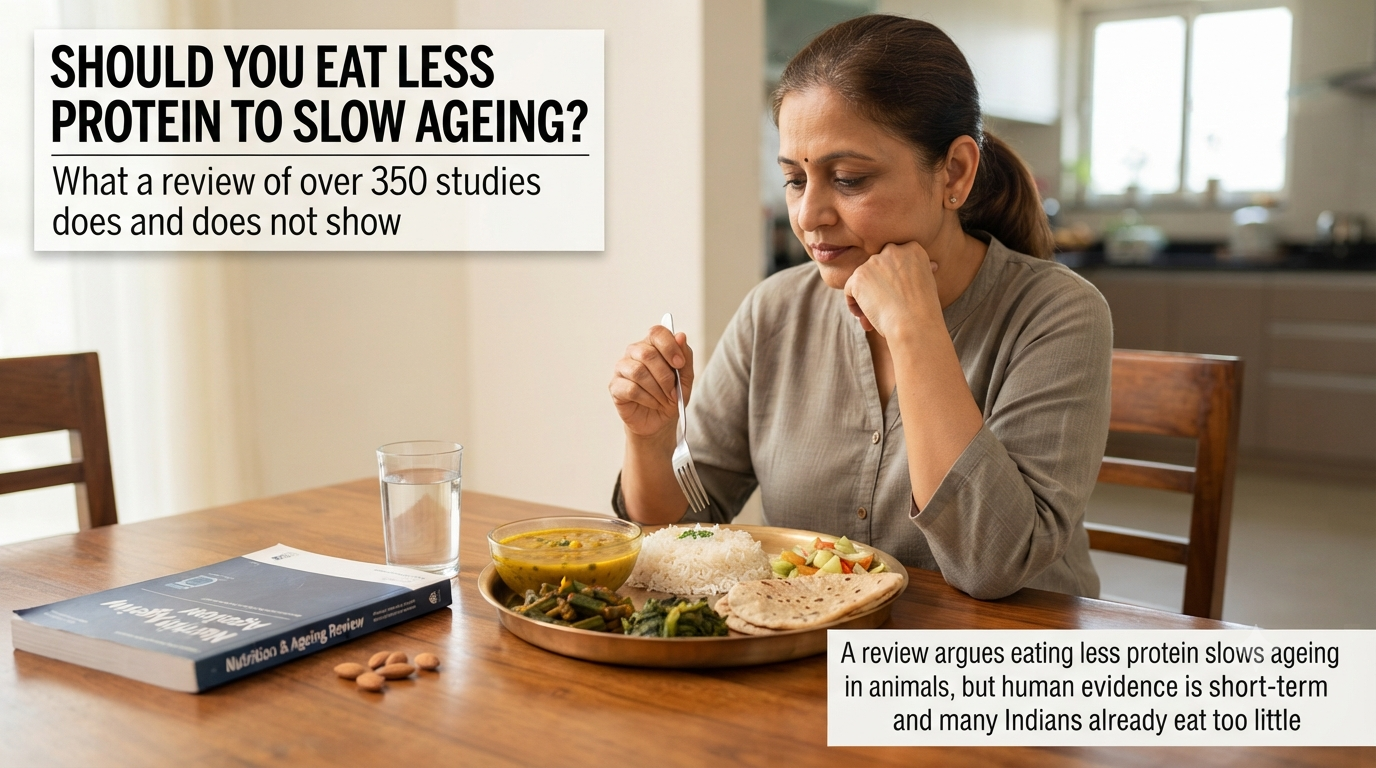
The review argues that eating less protein, or less of certain amino acids, slows ageing and improves metabolic health. It was written by Bailey Knopf and Dudley Lamming of the University of Wisconsin-Madison and published in Cell Press Blue in August 2026. It drew wide attention in November 2026 after a university news release said it covered more than 350 studies.
The authors highlight three amino acids, methionine, isoleucine and valine, whose restriction reproduces many of the benefits seen with lower-protein diets in animals. They also point to a hormone called FGF21, which rises when protein intake falls and which helped mice live longer in experiments.
How strong is the evidence in people?
The human evidence is limited to short trials of metabolic markers; none measured lifespan or long-term ageing. In flies and rodents, lower-protein diets extended life even without fewer calories. In people, the trials cited in the review's full text lasted from one to about six weeks.
| Human study cited in the review | Length | What changed |
|---|---|---|
| Low-protein diet in adults | 43 days | Lower weight, fat mass and fasting blood sugar, despite eating more calories |
| Lower protein in lean men | 5 weeks | Better insulin sensitivity, more energy used |
| Lower protein in metabolic syndrome | 27 days | Less body fat, better insulin sensitivity, lower blood sugar and fats |
| About 60% fewer branched-chain amino acids | 4 weeks | Better blood sugar control, higher FGF21 |
The review itself does not tell individuals to eat less protein. It calls for clinical research to design suitable diets and to work out how personal factors change protein needs. The press release quoted the authors as saying the human findings do not establish that cutting protein extends human life.
Who should not cut protein?
The authors list several groups who may need more protein, not less: pregnant women, growing children, people eating few calories, people recovering from injury and people who exercise. They also note that many older adults already eat too little protein, and restriction could push them into deficiency.
One observational study in the review found that older adults eating 1.2 g of protein per kg of body weight a day lost about 40% less muscle over three years than those eating 0.8 g. Exercise can largely offset muscle loss on lower-protein diets, the review adds.
For anyone cutting calories to manage weight, the 'people eating few calories' group is the important one. A lower-calorie diet that is also low in protein makes it harder to keep muscle.
How much protein do Indians need and eat?
ICMR-NIN advises adults to eat about 0.83 g of protein per kg of body weight a day. That figure, in its 2020 nutrient requirements, replaced the earlier 1 g per kg; the average requirement is 0.66 g per kg. For a 60 kg adult, 0.83 g per kg is about 50 g a day.
Indian diets already tend to be low in protein. The ICMR-INDIAB study of 18,090 adults, published in Nature Medicine in 2025, described them as high in low-quality carbohydrate and saturated fat and low in protein.
The same study modelled swapping some carbohydrate calories for plant, dairy, egg or fish protein and found lower odds of type 2 diabetes (odds ratios 0.89 to 0.91) and prediabetes (0.82 to 0.94). That is an observational link, but it points the opposite way from the review's advice for well-fed populations.
What our food data shows
Our Explore Food data shows how an ordinary vegetarian day builds up protein. These values come from tested recipes and the Indian Food Composition Tables.
| Food (NutriPedia serving) | Protein g | kcal | Protein per 100 kcal |
|---|---|---|---|
| Toor dal, cooked, 1 bowl (210 g) | 11.3 | 217 | 5.2 g |
| Rajma, 1 bowl (260 g) | 12.7 | 290 | 4.4 g |
| Chole, 1 bowl (200 g) | 9.2 | 232 | 4.0 g |
| Curd, plain, 1 katori (100 g) | 3.5 | 61 | 5.7 g |
| Cow's milk, whole, 1 cup (206 g) | 6.7 | 150 | 4.5 g |
Two bowls of toor dal, a katori of curd and a cup of milk give about 33 g of protein. Add four rotis (about 3 g each in our data) and the day reaches about 45 g, still a little short of the 50 g a 60 kg adult needs. Few Indian vegetarians are at risk of eating too much protein from food alone.
Should you stop taking protein supplements?
The review is not about supplements, but India's own guidance already advises caution. ICMR-NIN's 2024 Dietary Guidelines for Indians recommend getting protein from food and advise against relying on protein supplements. For most people, a powder adds little that a balanced diet with pulses, dairy or eggs cannot provide.
One more point on the review: Dudley Lamming has received funding from, and sits on the scientific advisory board of, Aeovian Pharmaceuticals, a company developing drugs that act on the same nutrient-sensing pathway, as the review's competing-interests statement says.