What did the new study find?
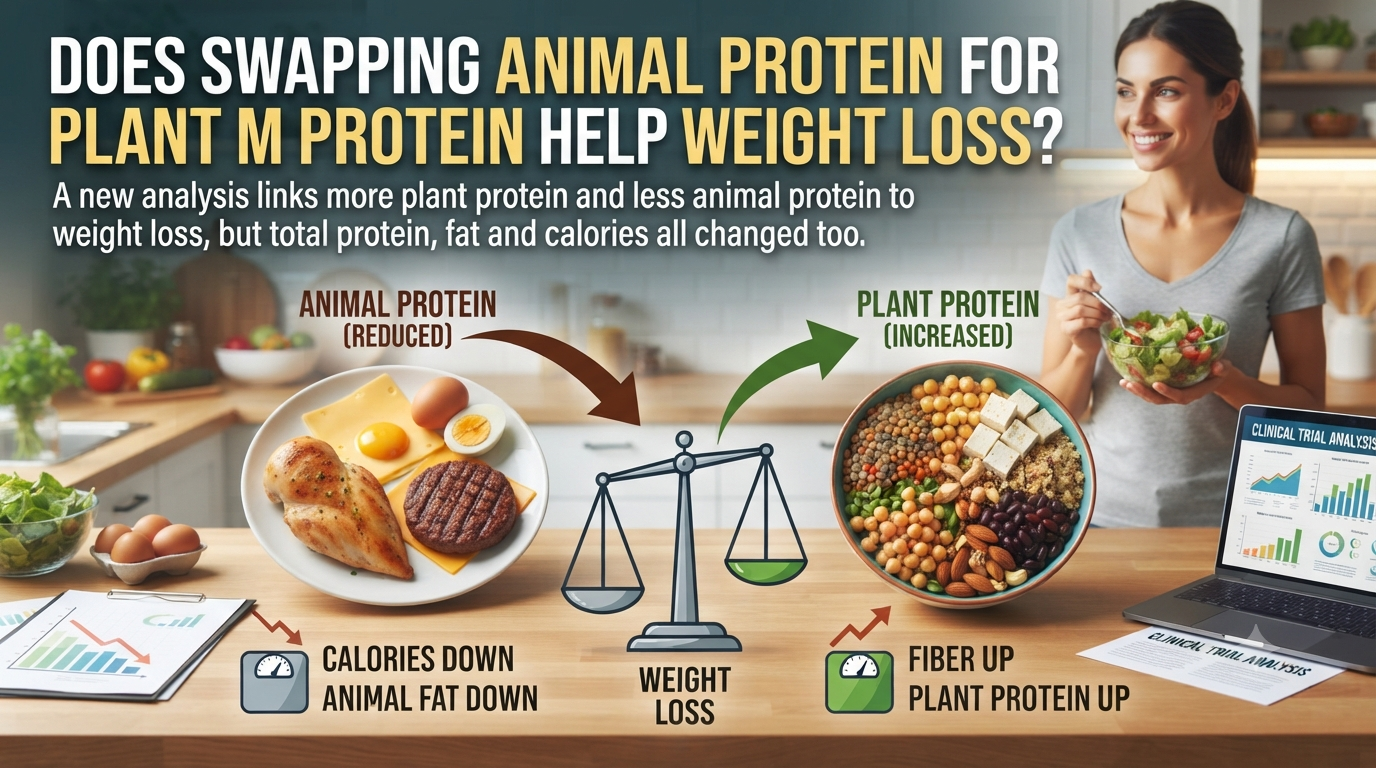
The study found that people who cut animal protein and ate more plant protein lost more weight, but it could not show that the protein swap caused the loss. It was published on 20 October 2026 in BMJ Nutrition, Prevention & Health by researchers from the Physicians Committee for Responsible Medicine (PCRM) in Washington, DC.
On the vegan diet, total protein fell by about 33 g a day, animal protein fell by about 48 g and plant protein rose by about 14 g. On the Mediterranean diet, none of these changed. Across participants, bigger falls in animal protein and bigger rises in plant protein went with more weight loss.
| Change during the vegan diet | Grams a day | Link with weight change |
|---|---|---|
| Total protein | -33.3 | Less protein, more weight lost (r = +0.34) |
| Animal protein | -47.7 | Less animal protein, more weight lost (r = +0.40) |
| Plant protein | +14.4 | More plant protein, more weight lost (r = -0.37) |
The authors also found that lower intakes of four amino acids (isoleucine, lysine, methionine and tyrosine), which are more plentiful in animal protein, went with greater weight loss.
How was the trial run?
This was a new analysis of a trial that ended in 2019. In the original randomised cross-over trial, 62 overweight adults in Washington, DC followed a low-fat vegan diet and a Mediterranean diet for 16 weeks each, in random order, with a 4-week break in between. Fifty-two people (84%) finished.
Nobody was told to eat fewer calories. The vegan diet aimed for 75% of energy from carbohydrate, 15% from protein and 10% from fat, with no animal products, added fats or cooking oils. The Mediterranean diet followed the PREDIMED pattern, with fish, nuts, legumes, vegetables and 50 g of extra-virgin olive oil a day.
People lost an average of 6.0 kg on the vegan diet and had no significant change on the Mediterranean diet. The new paper used three-day food records from the trial to see which protein changes tracked the weight changes.
Why can't the study say plant protein caused the weight loss?
Because almost everything about the diet changed at once. The authors write that during the vegan phase, fat fell from about 38% to 17% of energy, carbohydrate rose from 42% to 69%, and dietary cholesterol fell by over 270 mg a day. Calorie density and fibre changed too.
Any of these changes could explain part of the weight loss, and the analysis cannot separate them. The authors themselves call the findings "hypothesis-generating" and say a trial is needed that changes only the protein source while keeping energy, fat and fibre the same.
The links found are moderate correlations (r of about 0.3 to 0.4), based on self-reported food records. That means protein change explains only a modest share of the differences in weight between people.
Who took part, and who funded it?
The participants were mostly women (about 78%), with an average age of 57, highly educated and all from one city, so the results may not apply to men, younger adults or people in other countries. They were volunteers who wanted to lose weight.
The study was funded by PCRM, which promotes plant-based diets, and three of the five authors are PCRM employees. The paper states that the funder did not influence the results. It was peer reviewed. The same group has published several other secondary analyses of this trial, so this is one more look at the same 62 people, not new evidence from a new group.
What does this mean for Indian diets?
Most Indian diets already get much of their protein from plants. Dal, chana, rajma, wheat and rice supply a large share of protein for vegetarians, along with milk and curd. The risk for many Indians is too little protein, not too much animal protein.
That matters because the vegan diet in this trial cut total protein by about a third. ICMR-NIN's 2020 requirements set adult protein at 0.83 g per kg of body weight a day, and suggest about 1 g per kg for diets based mainly on cereals, because cereal protein is of lower quality. Cutting protein below this is not what the study supports.
Pulses help with this. Raw toor, chana and masoor dal have about 22 to 24 g of protein per 100 g (IFCT 2017), and eating them with rice or roti improves the overall protein quality, because cereals and pulses supply different amino acids.
How much protein do common Indian plant foods give?
A usual portion of dal or rajma gives about 11 to 13 g of protein, based on the portions and nutrition in NutriPedia's Explore Food pages. These foods also bring fibre, which helps you feel full.
| Food (usual portion) | Protein g | kcal | Fibre g |
|---|---|---|---|
| Rajma (260 g bowl) | 12.7 | 290 | 12.0 |
| Toor dal, cooked (210 g bowl) | 11.3 | 217 | 5.3 |
| Masoor dal (220 g katori) | 11.2 | 218 | 5.7 |
| Chole (200 g bowl) | 9.2 | 232 | 13.0 |
| Roasted chana (30 g handful) | 6.5 | 99 | 4.6 |
| Sprouted moong (100 g katori) | 3.0 | 30 | 1.8 |
Values are calculated from NutriPedia's Explore Food data, built on IFCT 2017 (ICMR-NIN) and USDA FoodData Central, using portions from three chefs' recipes where a dish is cooked.
Is the cooking oil the bigger lesson?
It might be. The vegan diet in this trial used no added oil at all, and fat fell to 17% of energy. A typical Indian dal tadka or sabzi is cooked with oil or ghee, and a tablespoon of oil adds about 120 kcal.
The study does not test oil separately, so we cannot say how much of the weight loss came from less fat. But a plant-based Indian meal cooked with a lot of oil is not the same diet as the one tested here.
What we do not know yet
We do not know whether swapping animal protein for plant protein, with calories, fat and fibre kept the same, changes body weight. No trial in this study did that. We also do not know whether the results hold for Indian diets, which start with far less animal protein than the American diets in this trial.