Do nuts make you put on weight?
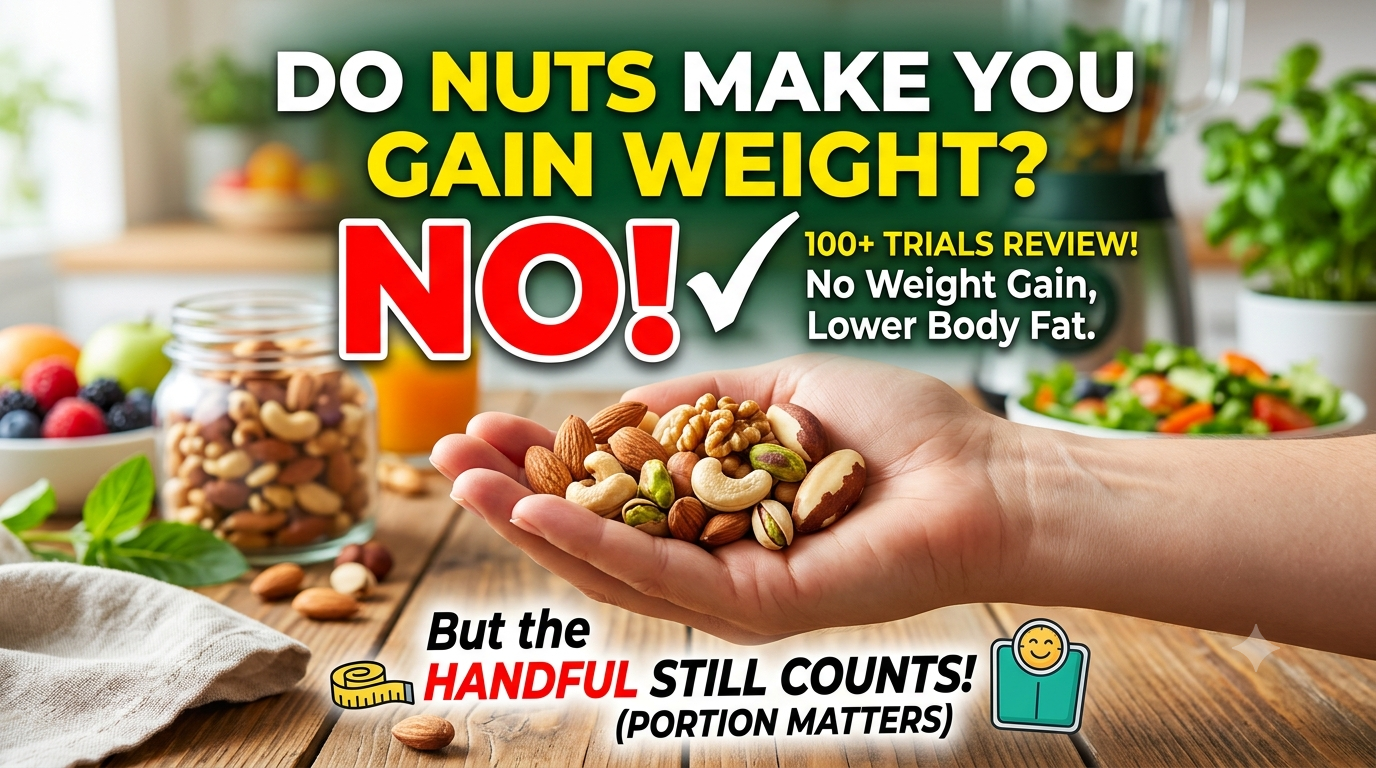
Nuts did not make people put on weight in the randomised trials reviewed so far. A systematic review and meta-analysis in the journal Foods, published online on 10 October 2026 by researchers in Singapore and South Korea, pooled the results of controlled trials in adults and found no change in body weight, body mass index (BMI) or waist size when nuts were added to the diet.
That matters because nuts are energy-dense. A 25 g handful of almonds gives about 150 kcal, and many people trying to manage their weight avoid nuts for that reason. The review suggests that fear is not borne out in trials, as long as portions stay sensible.
What did the new review find?
The review found a small drop in body fat and no change in weight. The authors screened 154 trial reports (119 separate trials) and pooled 102 of them. The median trial lasted 21 weeks, and the nuts tested were whole tree nuts or peanuts, not nut butters, oils or mixed products.
| Measure | Pooled change with nuts | Certainty of evidence |
|---|---|---|
| Body weight | +0.03 kg (no real change) | Low |
| BMI | -0.02 (no real change) | Low |
| Waist | -0.46 cm (not significant) | Very low |
| Fat mass | -0.41 kg | Moderate |
| Body fat percentage | -0.29 points | Moderate |
| Lean mass percentage | +0.71 points | Moderate |
| Energy eaten | +120 kcal a day | Very low |
The certainty ratings use the GRADE system, which judges how far the pooled result can be trusted. "Moderate" means the true effect is probably close to the estimate; "low" and "very low" mean it could be quite different.
Why don't the extra calories show up on the scale?
The review cannot say for sure, but the extra energy from nuts did not turn into weight gain in these trials. People ate about 120 kcal a day more on average, mainly because most trials asked them to add nuts to their usual diet.
Earlier research offers some likely reasons. A US Department of Agriculture feeding study found that people absorbed about 129 kcal from a 28 g serving of almonds, about a quarter less than the 170 kcal printed on labels, because some of the fat stays locked in the nut's cell walls. Nuts are also filling, so people may eat a little less of other foods later.
These explanations come from other studies. The new review found too few trials on appetite and energy use to test them properly.
Do some nuts work better than others?
The body-fat results were clearest for nuts rich in monounsaturated fat, such as almonds, cashews, peanuts and pistachios, but the difference from other nuts was not statistically significant. Walnuts, which are richer in polyunsaturated fat, gave less clear results.
The authors call this part exploratory. Nuts differ in protein, fibre and other nutrients as well as fat type, so the comparison cannot show that one kind of fat explains the effect.
What happened when people were also cutting calories?
In trials where both groups were on a reduced-calorie diet, the nut groups kept more lean mass (about 0.97 kg) and lost slightly more fat (about 0.51 kg). When nuts replaced carbohydrate-rich foods, fat mass was about 0.5 kg lower than in the comparison group.
These subgroups are smaller, so the numbers are less certain than the main result. They do fit the idea that nuts work best as a swap rather than an extra.
How strong is the evidence?
The evidence is moderate for body fat and low for body weight. The trials varied widely in length (from 2 weeks to 5 years), in the people studied and in how body fat was measured, mainly by DXA scans or bioelectrical impedance scales, which do not always agree.
The authors also found signs that some small studies with striking results may be over-represented. The review was funded by Seoul Women's University, and the authors declared no conflicts of interest. It does not tell us about long-term health outcomes.
How does this fit with earlier research?
It agrees with earlier reviews. A 2021 review in Obesity Reviews that pooled 86 trials and six long-term cohort studies found that nuts did not increase body weight (a pooled difference of 0.09 kg), and that people who ate more nuts tended to gain less weight over time.
A 2021 network meta-analysis in Nutrients compared individual nuts and found no rise in any measure of body fat with any nut except a small increase in waist size with hazelnuts. The new review adds body-composition detail: less fat, a slightly higher share of lean mass.
How many calories are in a handful of nuts?
A 25 g handful of common Indian nuts gives about 145 to 150 kcal. These are the figures behind our Explore Food entries, which are still in editorial review, taken from the Indian Food Composition Tables 2017 (ICMR-NIN) and USDA FoodData Central.
| Snack (portion) | Energy kcal | Protein g | Fibre g | Source |
|---|---|---|---|---|
| Almonds (25 g) | 152 | 4.6 | 3.3 | IFCT 2017 |
| Cashew nuts (25 g) | 146 | 4.7 | 1.0 | IFCT 2017 |
| Roasted peanuts (25 g) | 147 | 6.1 | 2.1 | USDA |
| Roasted chana (30 g) | 99 | 6.5 | 4.5 | IFCT 2017 |
Peanuts give the most protein of the three nuts and usually cost far less than almonds or cashews. Roasted chana is a pulse, not a nut, but it is a common lower-energy alternative with more fibre.
Do salted, fried or masala nuts count?
No, the review only covered plain whole nuts. It left out nut butters, oils, mixed products and nuts combined with other foods. Fried, salted, sugar-coated or masala nuts and nut-based sweets add oil, salt or sugar, and these results cannot be assumed to apply to them.