What did the study look at?
The study looked at whether people who ate more ultra-processed food were more likely to develop colorectal (bowel) cancer. It was published in PLOS Medicine on 15 October 2026 by researchers at the US National Cancer Institute, using the NIH-AARP Diet and Health Study.
The study followed 461,682 adults aged 50 to 71 who were cancer-free when they filled in a food questionnaire in 1995 or 1996. Over a median of 18.8 years, 10,075 of them developed colorectal cancer. Each food on the questionnaire was sorted using the Nova system, which groups foods by how much industrial processing they have been through.
What did it find?
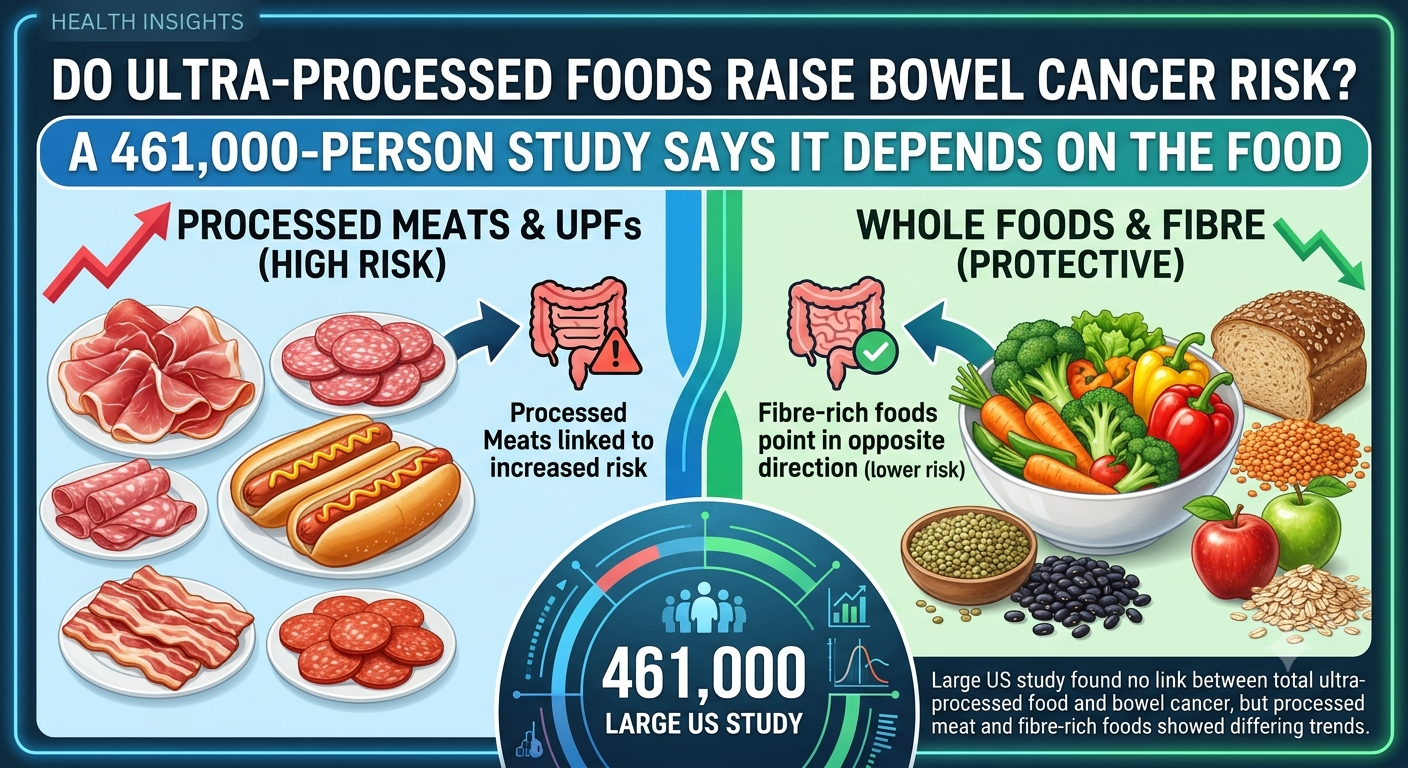
Total ultra-processed food was not linked to colorectal cancer. People in the top fifth for ultra-processed food intake had about the same risk as people in the bottom fifth (hazard ratio 0.97, 95% confidence interval 0.91 to 1.03). On average, ultra-processed foods made up 43% of the participants' energy.
Different kinds of ultra-processed food pointed in opposite directions, which may explain why the total showed nothing.
| Ultra-processed food group (highest vs lowest fifth) | Change in risk | Hazard ratio (95% CI) |
|---|---|---|
| Packaged breads | 9% lower | 0.91 (0.86 to 0.97) |
| Breakfast cereals | 16% lower | 0.84 (0.79 to 0.90) |
| Frozen desserts and milk drinks | 18% lower | 0.82 (0.77 to 0.88) |
| Reconstituted meat and fish products | 10% higher | 1.10 (1.04 to 1.18) |
A hazard ratio below 1 means lower risk and above 1 means higher risk. These are differences in relative risk, not the chance that any one person develops cancer.
Was it the processing or the nutrients?
The nutrients explained more than the processing. When the researchers looked at fibre, whole grains, dairy and calcium, these were linked to lower risk whether they came from ultra-processed foods or not, and meat was linked to higher risk from both kinds of source.
For example, each extra 10 g of fibre a day from ultra-processed sources was linked to 28% lower risk, and each daily serving of processed meat products to 8% higher risk. Swapping 10% of ultra-processed food (by weight) for minimally processed food was linked to about 2% lower risk (hazard ratio 0.98).
The authors concluded that foods should be judged on what they contain and their known health links, not on processing level alone. Their results fit existing bowel cancer advice: eat whole grains, fibre and dairy, and limit processed meat.
Does this mean ultra-processed food is fine for weight?
No. This study measured cancer, not weight, and trials on weight point the other way. In a 2019 US inpatient trial, 20 adults ate about 500 kcal a day more on an ultra-processed diet than on an unprocessed one when they could eat as much as they wanted, and gained about 0.9 kg in two weeks.
A 2025 UK trial gave 55 adults two diets that both met national healthy-eating guidelines, one minimally processed and one ultra-processed. Weight fell by 2.06% on the minimally processed diet and 1.05% on the ultra-processed one. So even when nutrients are matched, processing may affect how much people eat.
How reliable is the study?
It is large and long, but it shows links, not cause and effect. Diet was recorded once, at the start, so changes over nearly two decades were missed, and the questionnaire was designed to measure nutrients, not processing.
The participants were mostly older white Americans recruited in the mid-1990s, and the authors could not assess food additives. They also note that one of their statistical assumptions did not hold. The study was funded by the US National Cancer Institute, which had no role in the analysis, and the authors declared no competing interests.
How much ultra-processed food do Indians eat?
We do not know precisely, but sales are rising fast. A 2023 WHO report with ICRIER found that retail sales of ultra-processed food in India grew by 13.37% a year in value from 2011 to 2021, with salty snacks growing faster than the average.
Sales are not the same as intake, so the 43% of energy seen in the US study should not be assumed for India. Indian diets also differ: processed meat is eaten far less, while packaged snacks, biscuits, sweets and sugary drinks are more common.
What is India doing about labels?
India is still deciding on front-of-pack warnings. In an affidavit to the Supreme Court, FSSAI proposed a red hexagon warning on packaged foods high in sugar, salt or fat, and on 28 September 2026 the Supreme Court reserved its order and questioned FSSAI's proposed one-year voluntary period. No order had been announced when we checked on 2 November 2026.
In the US, the FDA and HHS sent a proposed definition of ultra-processed food to the White House budget office in August 2026 as a white paper rather than a rule, so it does not by itself change labels.
How does NutriPedia judge processed foods?
NutriPedia judges foods and products on what they contain, which is also the direction this study points to. Our Explore Food scores are built from energy density, protein, fibre and added sugar per portion, and our product ratings use label checks, cost and evidence for the purpose the product is sold for.
Many of the products we rate, such as meal replacements and protein powders, are ultra-processed by the Nova definition. A processing label alone does not tell you whether a product suits weight management; its energy, protein, fibre and sugar per serve tell you more.