What did FSSAI announce?
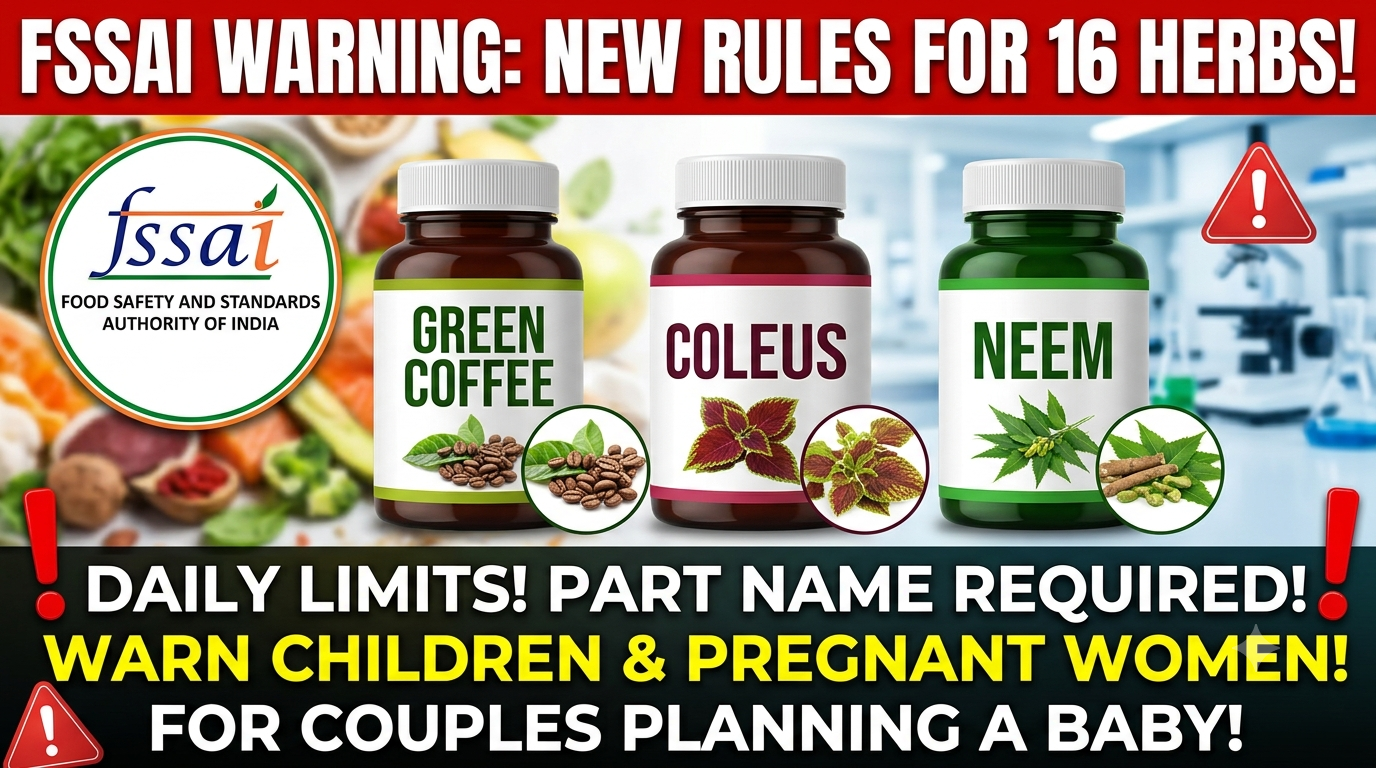
FSSAI's Regulatory Compliance Division issued an advisory dated 15 October 2026 to all food businesses and to every state's Commissioner of Food Safety. It says several companies making health supplements, nutraceuticals and foods for special dietary or medical use were leaving out warning statements that the law requires for certain plant ingredients.
The advisory does not create a new rule. It points back to Schedule IV of the 2016 regulations for health supplements and nutraceuticals, the list of plants these products may contain. Working with the Ministry of Ayush, FSSAI has gathered the 16 plants that need a caution into one annexure, so companies cannot say they missed one.
Companies have been told to review their labels and formulas. The advisory says a missing warning is a violation that attracts action under Section 52 of the Food Safety and Standards Act, 2006, the penalty for misbranded food, and can also lead to suspension or cancellation of licences. It also repeats that these products may not make medicinal claims.
Which herbs are on the list?
The table below is our summary of FSSAI's annexure. Each limit is the most an adult should take in a day, counted as the raw plant, so an extract is counted by the amount of plant it was made from.
| Plant (common name) | Part used | Adult limit a day | Caution on the label |
|---|---|---|---|
| Neem | Leaf | 1 to 3 g, as powder | Not for men and women planning to conceive |
| Neem | Fruit | 1 to 2 g, as pulp | Not for those planning to conceive or children below 5 |
| Papaya | Unripe fruit | 30 to 50 g | Not during pregnancy |
| Papaya | Leaf or juice | 5 to 10 g or ml, as decoction | Not during pregnancy |
| Kundru (ivy gourd) | Leaf | 5 to 10 g | Not for children below 5 |
| Coffee (green or dry) | Seed | 3 to 5 g | Not for children below 5 |
| Coleus (forskolin) | Root, leaf or whole plant | 3 to 5 g, as powder | Not for children below 5 |
| Carrot (gajar) | Seed | 1 to 2 g, as powder | Not during pregnancy |
| Snuhi (thuhar) | Leaf | 3 to 5 g, fresh | Not for children below 5 or pregnant women |
| Hibiscus (gudhal) | Flower | 1 to 3 g, as powder | Not during pregnancy |
| Kaladana | Seed | 3 to 5 g | Not for children below 5 or pregnant women |
| Garden cress (halon) | Seed | 3 to 6 g, as powder | Not during pregnancy |
| Nishoth (trivrit) | Root or seed | 1 to 3 g | Not for children below 5 |
| Betel (paan) | Leaf | 2 to 5 g | Not for children below 5 |
| Chitrak | Root | 1 to 2 g, as powder, after purification | Not for children below 5 or pregnant women |
| Putranjiva | Fruit seed kernel | 3 to 6 g | Not for children below 5 |
| Chukra (ambat chukka) | Leaf | 10 to 20 g | Not for children below 5 |
| Indrayan (inder vaaruni) | Root or fruit | 0.5 to 1 g, as powder | Not for children below 5 or pregnant women |
Neem and papaya each appear twice because different parts carry different limits, which is why the plant part must be printed on the label.
Why do green coffee and coleus matter most for weight management?
Green coffee extract and coleus (sold as forskolin) are two of the plants on this list most often found in capsules and powders sold for weight management. Green coffee beans are unroasted coffee seeds, rich in chlorogenic acids and still containing caffeine. Forskolin comes from the root of Coleus forskohlii, a plant of the mint family used in Ayurveda.
Both carry the same caution: not recommended for children below 5 years. That matters because these products often sit in family kitchens, and a child may take a powder or capsule meant for an adult.
Does green coffee or forskolin help with weight management?
The evidence is weak for both. A review of trials of green coffee extract found three suitable studies with 142 people in total. People taking the extract lost about 2.5 kg more than those on a dummy capsule, but the reviewers judged all three trials to be at high risk of bias and called for better studies (Onakpoya 2011).
For forskolin, a 12-week trial in 30 men with overweight found a change in body fat but no clear difference in body weight compared with a dummy capsule (Godard 2005). A similar trial in 23 women found that it did not lead to weight loss (Henderson 2005).
So neither plant has good evidence for weight management. A warning label does not mean a product works; it only tells you how to use it within safe limits.
What do NutriPedia's ratings check?
We have not rated green coffee or coleus products yet. When we rate any product, our method caps the overall rating at 2.0 if the label has no FSSAI licence number, and at 2.5 if it makes a claim that is not permitted, such as an unapproved weight-loss claim. Our evidence rating compares the amount of each active ingredient with the amounts used in studies, and our ingredients rating gives a point only when the amounts of key ingredients are printed.
A label that hides how much green coffee or coleus is in each dose makes it impossible to check against FSSAI's limits, and our ratings mark it down for that.
How do I check a herbal supplement label?
- Find the plant's name and the part used, for example "Coffea arabica, green seed extract".
- Find the amount in a daily dose and compare it with the limit in the table above.
- Look for the caution line, such as "not recommended for children below 5 years".
- Look for the 14-digit FSSAI licence number.
- Skip products that promise quick results or claim to treat a disease; these products are not allowed to make such claims.
What happens next?
The advisory gives no grace period. State food safety officers can now check labels against FSSAI's single list, and products without the caution can be acted against as misbranded. If you find a supplement with one of these plants and no warning, you can report it through FSSAI's Food Safety Connect app or your state's food safety office.