What are Amul High Protein Cubes?
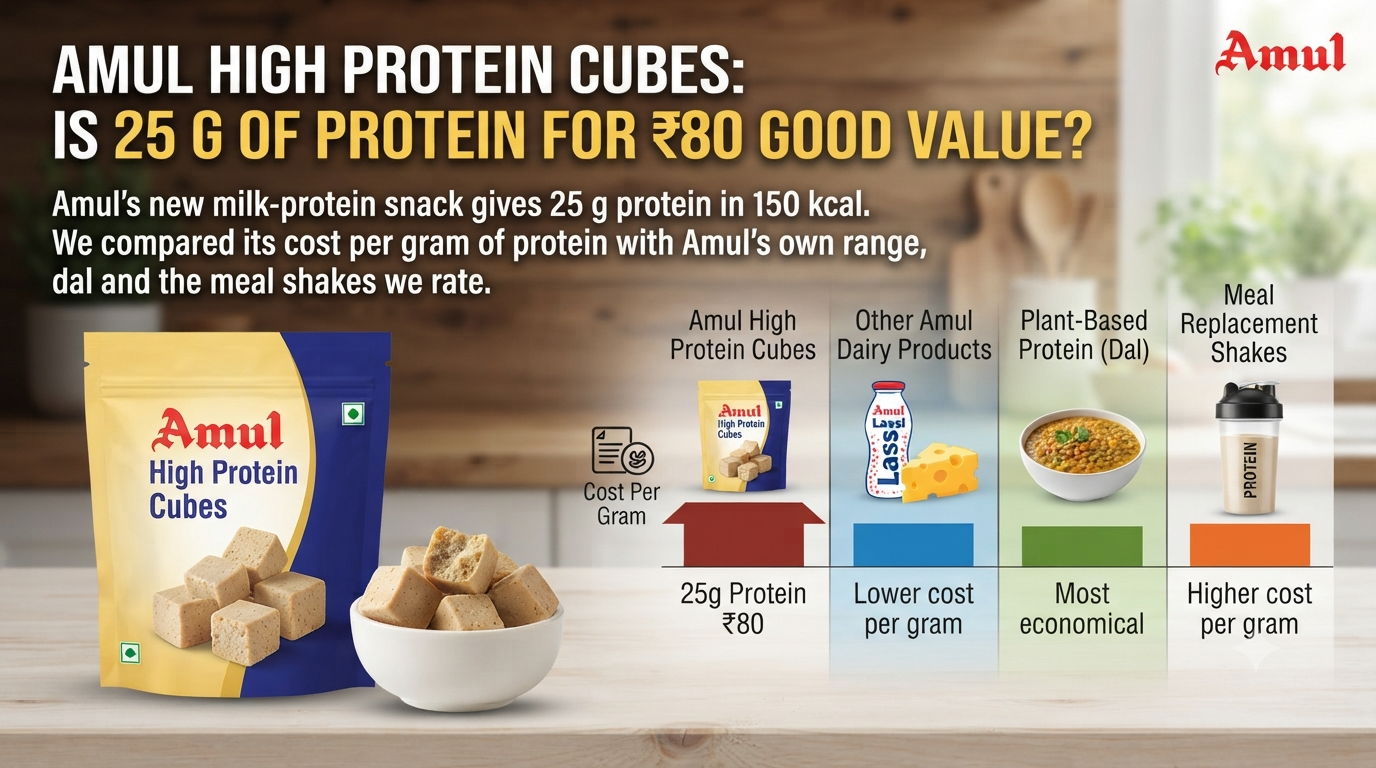
Amul High Protein Cubes are a crunchy, ready-to-eat snack made only from milk protein. On Amul's online store, each 38 g pack is listed with 25 g of protein and 150 kcal, which means about 65% of the pack's weight is protein.
The ingredient list is short: milk solids, iodised salt, an acidity regulator (575) and a cheese flavouring. Each pack comes with a separate seasoning sachet in one of five flavours: peri peri, Korean kimchi, tandoori, cheese and herbs, and tomato.
Amul's brand manager announced the product on X on 30 October 2026, and the store lists it at ₹400 for a box of five packs (₹80 a pack). When we checked on 10 November 2026, it was marked sold out, with a limit of two boxes per order.
Is 25 g of protein in 150 kcal a lot?
Yes, it is a very lean source of protein. Protein gives 4 kcal a gram, so 25 g of protein accounts for 100 of the 150 kcal; the other 50 kcal come from fat and carbohydrate. That works out to about 17 g of protein per 100 kcal.
For comparison, plain paneer gives about 6 g of protein per 100 kcal, a boiled egg about 9 g and cooked toor dal about 5 g, based on the Indian Food Composition Tables (ICMR-NIN) values we use in Explore Food. Very few everyday foods come close to 17 g, which is why milk-protein products like this appeal to people trying to eat fewer calories while keeping protein up.
One gap: the store listing shows protein and energy but not the fat, carbohydrate or sodium per pack, and it does not say how much salt the seasoning sachet adds. Those numbers will be on the printed label, and they matter for anyone watching salt.
How does the price compare with Amul's other protein products?
The cubes cost about the same per gram of protein as Amul's whey sachets and milk, and about twice as much as its paneer, lassi or atta. We worked out the cost per gram of protein for each product from the protein and MRP on Amul's online store on 10 November 2026, using the largest pack listed.
| Amul product (serving) | Protein g | kcal | Price per serving ₹ | ₹ per g protein |
|---|---|---|---|---|
| High Protein Paneer (50 g) | 12.5 | 85 | 20.60 | 1.65 |
| High Protein Plain Lassi (200 ml) | 15 | 107 | 30 | 2.00 |
| High Protein Buttermilk (200 ml) | 15 | not listed | 30 | 2.00 |
| High Protein Wheat Flour (65 g) | 20 | not listed | 40 | 2.00 |
| High Protein Milk (250 ml) | 35 | 225 | 110 | 3.14 |
| Whey Protein sachet (32 g) | 25 | not listed | 80 | 3.20 |
| High Protein Cubes (38 g) | 25 | 150 | 80 | 3.20 |
| Kool Protein Milkshake (180 ml) | 10 | 133 | 40 | 4.00 |
What you pay extra for is convenience: the cubes need no fridge, no shaker and no cooking, and they can be eaten like a namkeen. The tinned paneer is the cheapest protein in the range, but it has to be cooked or eaten in a meal.
Is it cheaper than dal or other home foods?
No. Everyday Indian foods give protein for much less. Amul's own store sells a 1.5 kg organic dal combo (chana, toor and masoor) for ₹303. Raw dal of these three kinds has 21.6 to 24.4 g of protein per 100 g (IFCT 2017), so the combo works out to roughly ₹0.90 per gram of protein, under a third of the cubes' cost.
Dal also brings fibre, which the cubes do not. A bowl of cooked toor dal (about 210 g) gives about 11 g of protein and 5 g of fibre for 217 kcal in our dal dishes data. The trade-off is energy: dal gives more calories for each gram of protein, and it has to be cooked.
| Food (usual portion) | Protein g | kcal | Fibre g |
|---|---|---|---|
| Amul High Protein Cubes (38 g) | 25 | 150 | not listed |
| Toor dal, cooked (210 g bowl) | 11.3 | 217 | 5.3 |
| Paneer, plain (50 g) | 9.5 | 153 | 0 |
| Boiled egg (50 g) | 6.7 | 74 | 0 |
| Roasted chana (30 g handful) | 6.5 | 99 | 4.6 |
| Curd (100 g katori) | 3.5 | 61 | 0 |
Values for home foods are from NutriPedia's Explore Food pages, built on IFCT 2017 (ICMR-NIN) and USDA FoodData Central.
How does it compare with the meal shakes NutriPedia rates?
On protein per rupee, the cubes beat every meal-replacement shake we rate. Using the label serving and the prices in our meal-replacement ratings (checked 2 to 8 November 2026), the shakes cost between ₹4.45 and ₹12.28 per gram of protein as powder, before any milk is added.
| Rated meal shake (label serving, powder only) | Protein g | Cost per serving ₹ | ₹ per g protein |
|---|---|---|---|
| OZiva Nutritional Meal for Women Chocolate | 20.8 | 92.64 | 4.45 |
| Herbalife Formula 1 Mango | 9 | 59.00 | 6.56 |
| Horlicks PRO Fitness Chocolate | 12.6 | 96.25 | 7.64 |
| Nestlé Optifast Vanilla | 19 | 159.50 | 8.39 |
| NeuMeal Nutty Harmony | 22 | 199.86 | 9.08 |
| NeuMeal Spicy | 18 | 185.57 | 10.31 |
| Abbott Ensure Chocolate | 8.3 | 101.93 | 12.28 |
This is not a like-for-like contest. A meal replacement is meant to stand in for a whole meal, with fibre, vitamins and minerals, and our ratings judge it on that, not on protein cost alone. The cubes are a snack that adds protein; they do not replace a meal and do not carry a full set of micronutrients.
We have not rated the cubes. Our product ratings cover meal replacements and a few supplement formats, and a protein snack would need its own category before we could score it fairly.
Do you need a protein snack at all?
Most adults can meet their protein needs from ordinary food. ICMR-NIN's 2020 requirements set the adult allowance at 0.83 g of protein per kg of body weight a day, about 54 g for a 65 kg man and 46 g for a 55 kg woman. The same note suggests about 1 g per kg for people whose diet is mainly cereal-based, because cereal protein is of lower quality.
A day with two bowls of dal, a katori of curd and a portion of paneer or two eggs already gets close to these figures. A protein snack helps most when meals are irregular, when appetite is low, or when someone is cutting calories and wants to keep protein steady.
ICMR-NIN's Dietary Guidelines for Indians (2024) also advise getting protein from food combinations such as cereals with pulses rather than relying on protein supplements. The cubes are a food made from milk solids, not a powder, but the same idea applies: they work best as one part of a varied diet.
What we do not know yet
We have not seen the full printed label, so we cannot say how much sodium or fat a pack and its seasoning add, or how the nutrition panel reads per 100 g. The product is also too new to have independent taste reviews in any number.
We will look again once the label is easy to check and the product is back in stock.